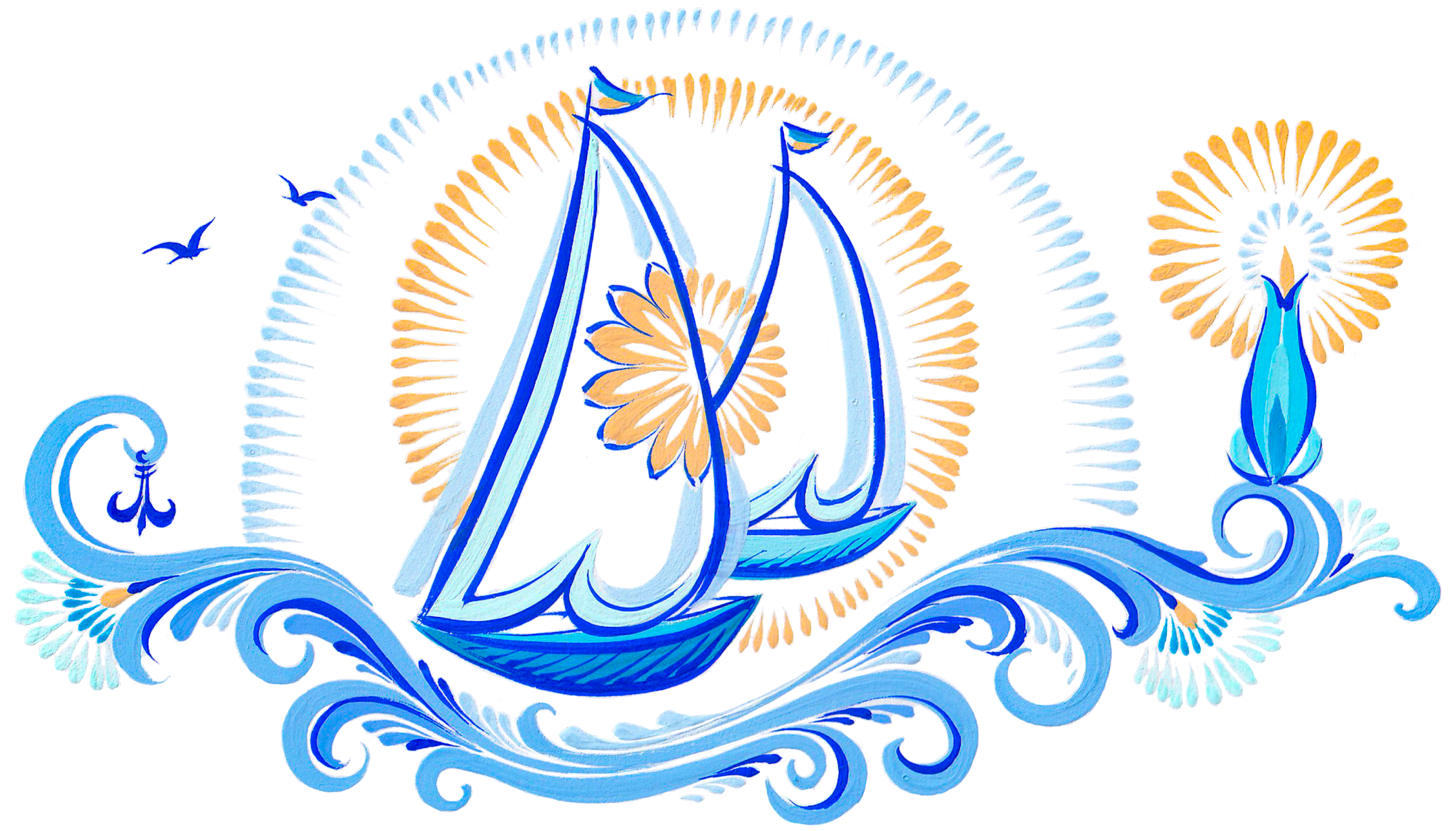
Абетка «таврійки»
Basic Strokes
In most paintings done with a brush there are similar elements; only the names differ. As a rule this is bound to the main theme of the painting or to the character of the technique. Usually there are five to ten basic strokes from which more complex elements are built, and those in turn have names of their own.
It is not hard to master the set of strokes of Tavrian painting — one need only show persistence. Technique and materials are not yet the painting, just as knowing letters does not make a person a writer. Letters make words, words make sentences, sentences make a text. They must carry a thought, hold information; only then is their existence justified.
So it is with painting. These are not simply “strokes.” They are encoded information that comes to us from the depth of the ages. They tell us, they pass on what cannot always be said in words; they are the wisdom of our ancestors, which has reached us in signs and symbols. So before taking up paints one must understand what important thing is hidden behind the “waves,” the “drops,” the “hooks.”
In her time Liubov Paraniuk faced the task of setting the strokes of the painting apart from historical sources. The search did not give the result she hoped for. So the master chose to go deep into the creative legacy of the researcher of Tavrian painting, the journalist Yevhenia Bondarenko.
Journalistic essays on the legends of the native land, works of publicistic and artistic literature that hold descriptions of the legends, notions and beliefs of our ancestors, authentic texts of songs, true tales and folk tradition — Liubov Paraniuk reread them several times over.
Most eloquent of all proved to be the paintings of Yevhenia Bondarenko. With elements of Tavrian painting laid over a painterly background, the journalist and artist succeeded in showing the notions of our ancestors, the character of life in the past, and the nature of Tavria.
Liubov Paraniuk concluded that some elements of Tavrian painting resemble elements of other well-known brush paintings, such as Petrykivka, Yavoriv, Poltava and others. Yet there is a difference, brightly present in the names of the elements — or, more precisely, in the meaning and idea carried by each stroke, and in their figurative and compositional pairings, closely bound to the natural and everyday surroundings of the people of the Black Sea coast.
The Ukrainian alphabet has 33 letters. From them one may make words; from words, sentences; and then, putting meaning into them and joining the sentences, write a text. So it is in painting: from the first simple elements, the mastery of which makes it possible to grasp the technique of Tavrian painting as a whole, more complex forms are built, and from those, in turn, narrative or ornamental compositions. In all, one may distinguish five basic elements and several auxiliary simple ones.
The most popular element of Tavrian painting. It is made with a light touch of the brush to the surface, beginning from the “tip” and ending with pressure at the “heel.” It may be made in different directions and may change in scale and in the curve of the “tip.”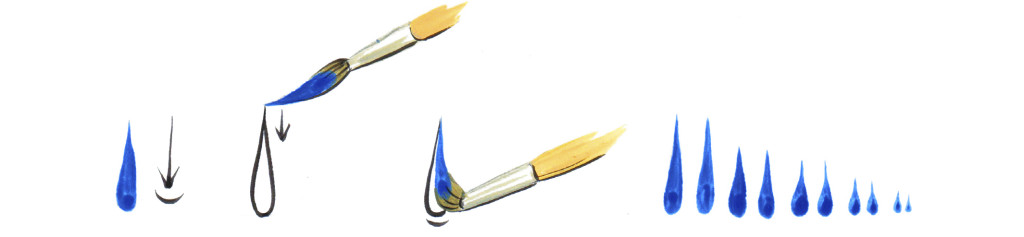
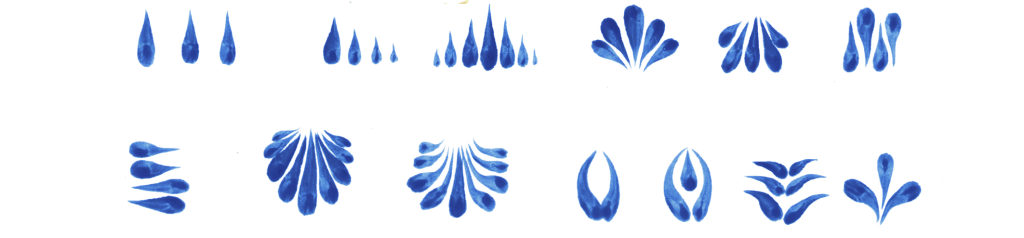
A stroke made with a horizontal movement, beginning from a thin tip. Then in the middle comes “pressure,” and it ends again in a “tip.”
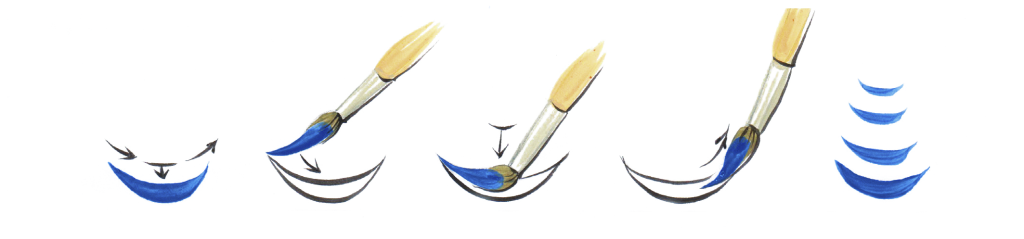
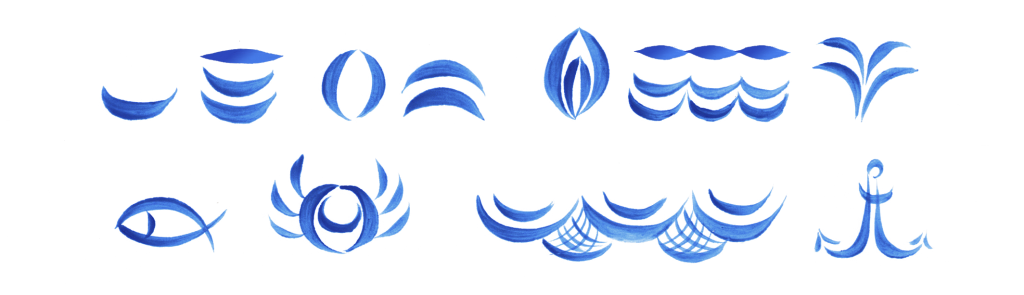
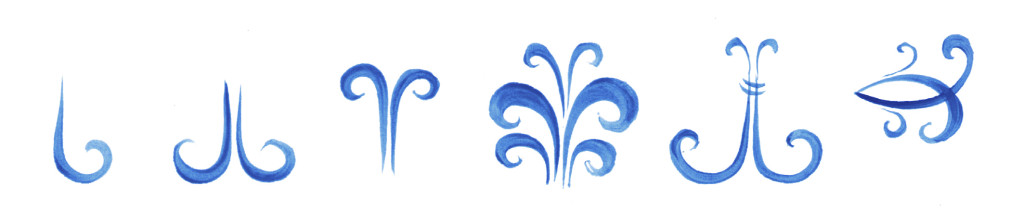
An element built on the previous stroke, but with a continuation in the form of a “curl.” The “curls” may be at both ends of the stroke; then it comes to resemble the symbol of infinity.
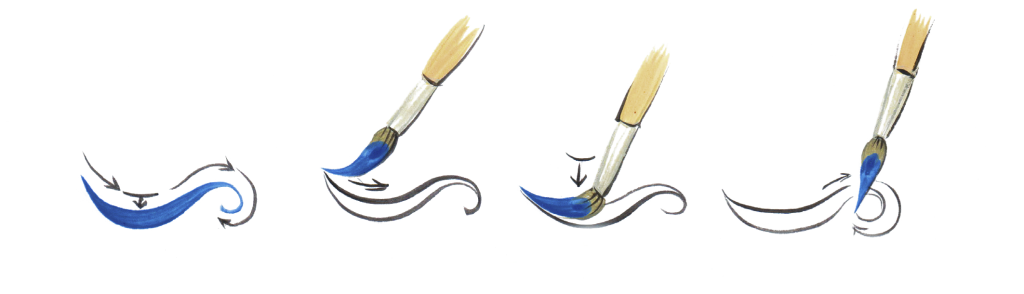
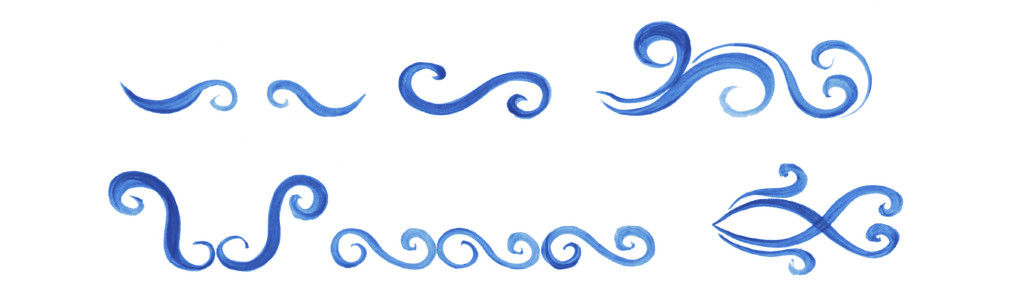
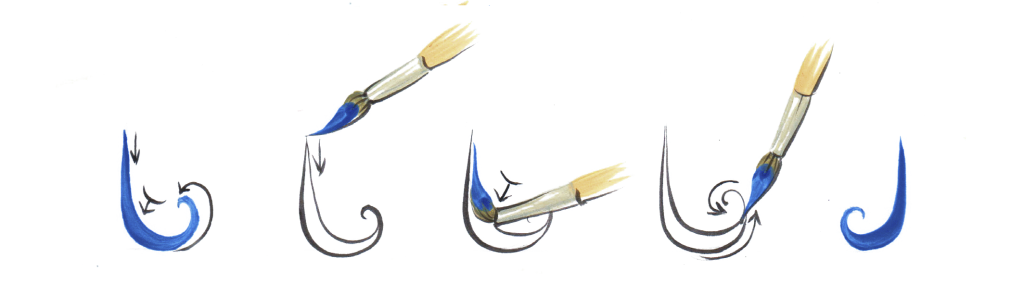
A vertical stroke that begins like a “drop,” but in place of the “heel” has a continuation in the form of a “curl” to the right or to the left; it may also be inverted.
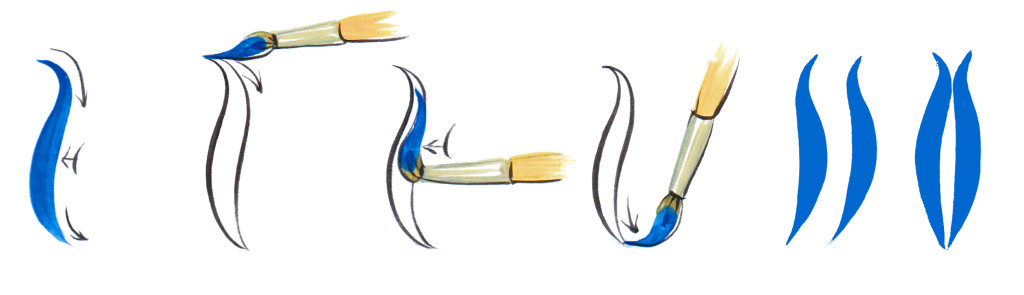
A vertical stroke resembling a “boat,” whose upper tip is curved in the opposite direction from the lower. It appears very often in the work of Yevhenia Bondarenko, and so Liubov Paraniuk set it apart.
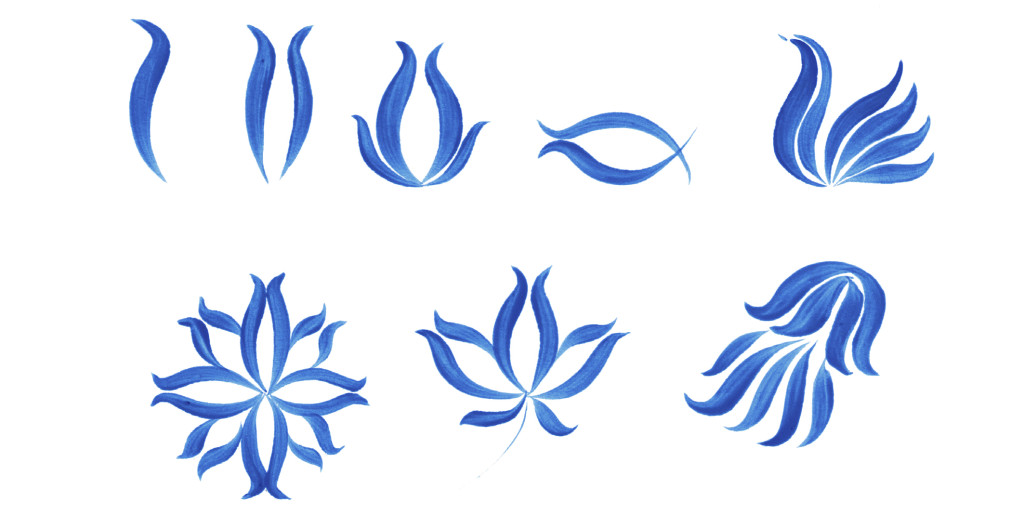
Elements that do not play a dominant part in the painting, but complement it well.
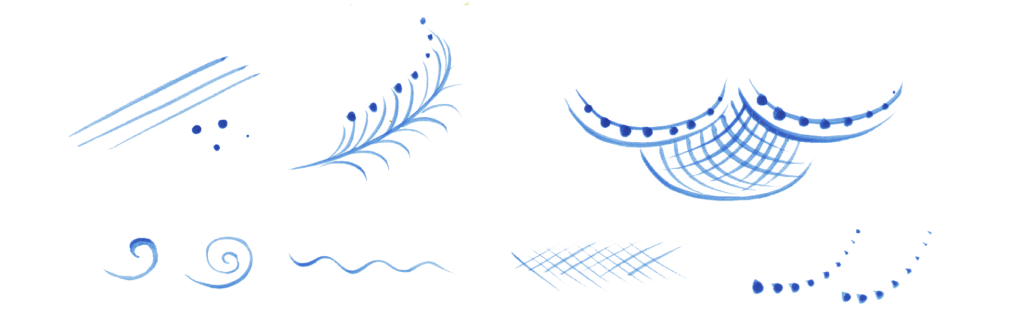
These are the “letters” from which more complex elements are built; and everything depends on the skill and imagination of the master.